|
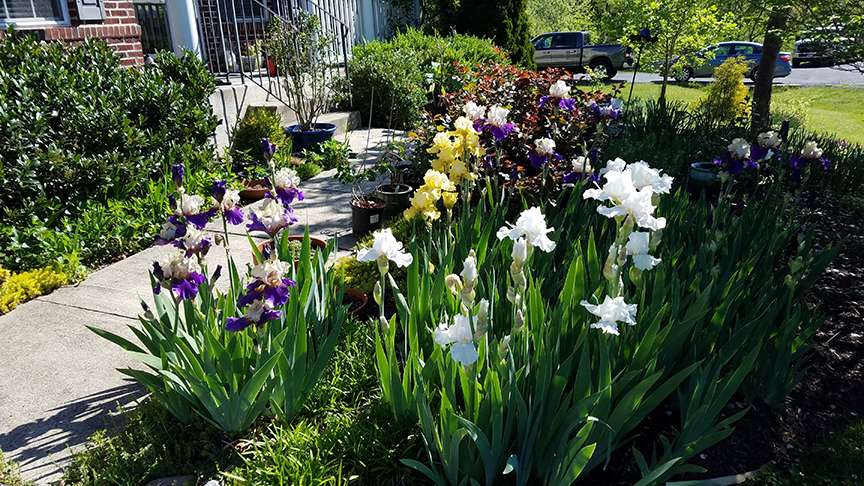
| White iris |
I's been such a cruel spring this year, with drought and wild swings in temperatures in my Zone 6B Virginia garden! The mid-April frost coming after an abnormally warm week not only blasted the emerging leaves and buds from my flowering trees, but the irises that were in spike as well. Only the patch of irises in the front yard, protected by the house, managed to bloom. As of a few days ago only the white ones, later than the rest, persisted. My peonies, which would be blooming about now, have only a few viable buds, and are late.
Me too--I'm late with this May Bloom Day, hosted by Carol Michel's May Dreams Garden blog, because I was taking an intense in-person painting workshop for four days, and had no time to write or post my photos. What you see were taken last week and/or some days ago; welcome to my May garden, such as it is.
 |
| Amaryllis on the porch |
The Amaryllis I got as a gift a couple of Christmases ago re-bloomed, and decorates my front porch. In the front yard a friend found and brought me some lovely rocks to build up a border edge for the bed under the trees, and I think it adds a little something to the overall look.
 |
| Front yard with new stone edging |
I like to plant some annuals in this front bed in an effort to camouflage the dying foliage of the daffodils and have something growing there during the summer, but usually deer come and eat most of the plants anyway. This year I'm hoping to foil them with a new deer repellent, but its effectiveness remains to be seen. I bought a few new perennials to add to the Gaillardia I planted a few years ago--a blue-flowered Lithodora, and a blue Pincushion flower (Scabiosa) at the edges of the trees where they'll get some sun.
Recently I planted three bare-root Astilbes under the dogwood tree to the left, but they'll take a while to emerge and bloom during the summer. I'll probably plant some Coleus later on when the daffodil foliage has died out completely.
 |
| Lithodora |
 |
| Gaillardia 'Arizona Sun' getting ready to make a show |
 |
| Blue Pincushion flower (Scabiosa) |
My Viburnum 'Brandywine' on the east side of the house did not sustain any damage, but the climbing rose 'New Dawn' and Clematis 'Etoile Violette' don't look very happy in the prolonged drought, with leaf miners blighting the rose. Neither does the Filicoides Cypress (Chamaecyparis obtusa filicoides). Only the dwarf blue spruce seems to have retained its normal lovely spring foliage.
 |
| Viburnum 'Brandywine' with blue spruce, Hinocki cypress and |
In the east woodland garden all three Japanese maples and the Virginia Fringe tree were blighted and are only now starting to put forth some foliage, but surely there won't be any flowers here this year. The flowers of the two Rhododendrons and the Pagoda dogwood were also blighted. Usually this part of my garden is so lovely during this season, but this year, only the 'Blue Barlow' columbines, which have spread everywhere, are blooming.
 |
| 'Blue Barlow' Columbines |
 |
| Rhododendron 'Southgate Brandi' under Japanese maple 'Bloodgood' |
I keep adding native plants to my woodland garden: this spring some wild ginger under the Carolina Silverbell tree, next to the Pink Turtlehead planted last year. And, I finally bought a reasonably-priced Helleborus niger, which I planted between the Japanese Full Moon maple and the Virginia Fringe tree. I acquired one bare-root plant of Trillium grandiflora I hope to plant as soon as I find some time.
Moving down to the back yard, the Foxglove Pentstemons are proving indestructible, and the Ninebark Tree 'Coppertina' in the badlands has some decent blooms, though not like in other years.
 |
| Foxglove Pentstemon |
 |
| Ninebark Tree 'Coppertina' |
A nice surprise in the back bed--one of the Snapdragons I planted last year survived the winter and is blooming--it seems taller this year, and definitely taller than the ones I just planted, which I think are exactly the same variety. I've learned that deer don't eat Snapdragons, so they're a good choice for my garden. So is Verbascum.
 |
Snapdragons |
 |
| Verbascum 'Southern Charm' |
The red honeysuckle 'Major Wheeler' has been very floriferous, and providing nourishment for the hummingbirds migrating north. The native red Columbines also attract the hummers.
 |
| Red Honeysuckle 'Major Wheeler' |
 |
| Red Columbines (Aquilegia canadensis) |
Another shrub that won't be flowering this year is the Philadephus 'Cheyenne'; the shrubs in that bed are so sad-looking! The Beautyberries died down to the ground and are just starting to re-sprout from their bases. The Honeylocust tree was looking dead, but seems to be sprouting some foliage now. Not worth photographing.
On the west side of the house the Salvia "May Night' is blooming with the round-leaved Coreopsis. The pink-flowered Sweetspire (Clethra alnifolia) behind the deer barrier is re-sprouting, but the Clematis I planted there last fall was eaten right down to the ground. Probably not a bad thing--this site is too hot for the 'Betty Corning' Clematis I'd purchased on sale. I bought a replacement, but I'm still trying to figure out where to plant it out of the reach of the deer, where the fragrance can be enjoyed.
 |
| Salvia 'May Night' with Coreopsis |
 |
| Clematis montana 'Appleblossom' |
The other Clematis on this side of the house has not performed well either--only a few blooms this spring. It badly needs pruning, but that will have to wait until after it's finished blooming.
This morning I spent an hour digging up a dead Ilex bush that was in front of the Clematis, preparing the ground for a new shrub--a dwarf Smokebush. It was back-breaking work in this heat (the outdoor thermometer is marking 96 degrees F as I write), digging up big rocks and the yellow clover taking over--I'm getting too old for this! I wish I could afford to hire two laborers to do this stuff for me, but my budget doesn't permit it, so I try to enjoy it, despite the backaches.
 |
| Dutch Iris |
 |
| Purple Dutch Iris |
The pale Dutch Iris flowers also got blighted, but the later-blooming purple ones are making a good show now. The Allium Moly is always dependable.
 |
| Allium moly |
That's about it for now, awaiting rain. Thanks for visiting!